They Didn't Hack Adobe. They Hired Their Way In.
- Dwight Samuels
- Apr 25
- 5 min read

Updated: Jun 7
# The Alleged Adobe Breach: A Deep Dive into Security Vulnerabilities
## The Breach That Exposed Adobe's Vulnerabilities
Note: Adobe has not confirmed this breach at the time of publication. The claims originate from a threat actor communicating with cybersecurity researchers, supported by screenshots and file directories reviewed by independent analysts. The architectural lessons apply regardless of final confirmation — because the attack chain described is real, documented, and running against organisations globally right now.
In early 2026, a threat actor known as Mr. Raccoon allegedly sent an email to an employee at a small outsourcing firm in India.
The email seemed routine. It contained a file that installed a Remote Access Tool. This software gave Mr. Raccoon complete control of the employee's workstation. He could access the camera, keyboard, files, and even private WhatsApp conversations.
This outsourcing firm handled customer support for Adobe. From that single workstation, Mr. Raccoon allegedly escalated his access. He crafted a convincing phishing message to the employee's manager, who approved a login. This broadened the access significantly. According to claims reviewed by multiple independent security researchers, Mr. Raccoon gained access to approximately 13 million customer support tickets, 15,000 employee records, and the entirety of Adobe's HackerOne bug bounty programme submissions.
The support tickets were damaging. The bug bounty submissions posed an entirely different problem.
The Locksmith's Filing Cabinet
Security researchers provide a service that many outside the industry may not know about. They identify vulnerabilities in software that attackers could exploit. Instead of exploiting these vulnerabilities, they report them privately to the affected company. The company investigates, fixes the vulnerability, and pays the researcher a reward: a bug bounty.
This process exists to enhance software safety. The documentation includes precise descriptions of the vulnerability, steps to reproduce it, conditions for exploitation, and potential impacts. It acts as a step-by-step manual for breaking into the system, held in trust by the company until the fix is implemented.
Imagine a locksmith who tests the security of buildings. They identify weak doors, bypass routes, and combinations that fail under certain conditions. They document everything and hand the report to the building owner. The owner promises to fix the issues and locks the report in a filing cabinet.
Now, imagine someone steals that filing cabinet.
This scenario represents the worst-case outcome in the Adobe breach claims. If the HackerOne submissions were taken and any vulnerabilities documented in those submissions remain unpatched, an attacker now possesses a detailed, researcher-authored manual for breaking into Adobe's products. These are not theoretical vulnerabilities. They are specific, verified, reproducible ones, written by professionals whose job is to find them.
Adobe's 700 million users include creative professionals, enterprises, government agencies, and educational institutions globally. The products implicated span the most widely deployed document and creative software in the world.
The Architecture Failure: One Export Request
The most revealing detail in the Mr. Raccoon claims did not stem from the stolen data. It emerged from a single sentence the threat actor shared with the researchers who interviewed him.
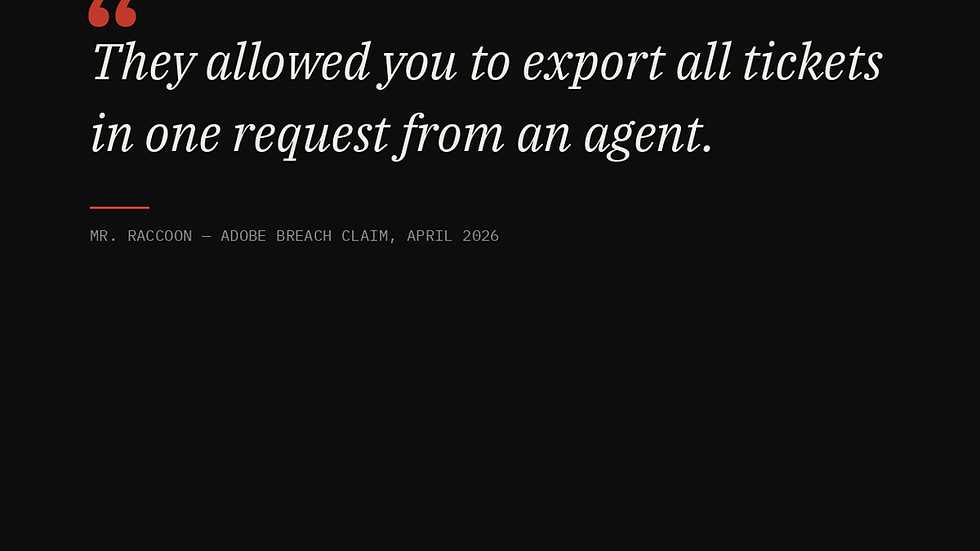
"They allowed you to export all tickets in one request from an agent."
Read that again. A single support agent account—one set of credentials held by an employee of a third-party outsourcing firm—had the technical capability to export all 13 million support tickets in one operation.
There was no bulk export approval workflow. No volume threshold triggered an alert. No second authorization was required for a request that could extract the entire contents of a customer support database.
This is not a sophisticated failure. It falls into the same category of failure as the Stryker wipe command we covered two weeks ago: a single credential with unilateral, irreversible, catastrophic capability, and nothing standing between it and execution.
The principle governing any system capable of bulk data extraction should mirror that of bulk data destruction: one person should not be able to do it alone. This is not about distrust; it's about the reality that credentials can be stolen, accounts can be compromised, and outsourced workforces operate at a distance from the security culture of the organizations they serve.
The BPO Problem Nobody Is Talking About
Business Process Outsourcing (BPO) is one of the largest industries globally. Hundreds of millions of customer service interactions, support tickets, claims processes, and data entry operations are handled daily by outsourced teams operating under service level agreements, not security policies.
For a CFO, BPO is a cost optimization. The math is straightforward: outsource support operations to lower-cost geographies, maintain service quality, and reduce headcount. The financial case is often compelling.
What does not appear in the financial model is the security exposure created when an outsourced agent's workstation becomes a node in your data architecture.
When a BPO employee's compromised laptop functions as a door into your customer database, the security training that the BPO firm provides—if they provide any—becomes the only control standing between an attacker and 13 million records.
The BPO firm in this case was not Adobe. It had no direct obligation to Adobe's customers. It had no regulatory exposure under breach notification law. It had, apparently, no technical controls preventing a single agent from exporting the entire support database or alerting when a workstation began behaving anomalously after malware installation.
Adobe almost certainly had a contract with this BPO that included a data processing agreement and security requirements. Whether those requirements addressed the specific controls that would have prevented this attack is the question every organization using outsourced support should be asking right now.
The Question That Changes Your Exposure
You do not need to use Adobe's products to face similar exposure. You need only to outsource any function that touches customer or employee data to a third-party provider.
Call centers, claims processing, technical support, finance operations, and HR administration are all functions that, when outsourced, create a network of workstations, credentials, and data access points. These operate at varying distances from your security standards.
The question to pose to your procurement and security teams is specific:
For every BPO or outsourced function that holds access to sensitive data, can you answer the following?
Does a single agent account have the technical capability to export bulk data without a second authorization?
If a workstation in that BPO is compromised tonight, what is the technical control—not the contractual requirement, but the actual technical control—that would detect it and block data exfiltration?
If the answer to the first question is yes, and the answer to the second is uncertain, you have the same architectural exposure that allegedly handed Mr. Raccoon 13 million records and a map of Adobe's unpatched vulnerabilities.
The servants' entrance does not appear on the security architecture diagram.
That is where this one came in. Every two weeks, I break down the breach that the sanitized advisory will reduce to a sentence. This way, you can see the full architectural failure before it becomes yours.
Subscribe below. The BPO on your vendor list right now may already be the weakest door in your building.


Comments